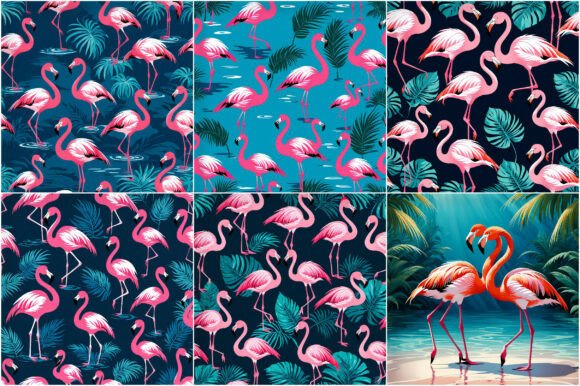
Dancing Flamingos Patterns: A Practical Review for Summer-Themed Design Projects
In the competitive landscape of digital design assets, finding patterns that balance aesthetic appeal with technical utility is often a challenge. Many tropical-themed collections suffer from either low resolution or repetitive, unnatural tiling. The Dancing Flamingos Patterns collection emerges as a specific solution for creators looking to inject energy and vibrancy into summer-focused projects. This asset pack offers a curated set of six high-resolution digital patterns featuring graceful flamingos and complementary tropical motifs. For professionals ranging from print-on-demand entrepreneurs to graphic designers working on seasonal campaigns, understanding the practical application and technical specifications of such resources is essential before integration into a workflow.
Visual Identity and Thematic Consistency
The core strength of this collection lies in its cohesive visual language. The term "dancing" implies motion, and the designs reflect this through dynamic poses and playful arrangements rather than static, rigid repetitions. This is a critical distinction for modern design trends, where organic flow is preferred over the blocky, grid-like repeats common in older pattern libraries. The inclusion of tropical motifs alongside the flamingos creates a complete environmental context, allowing designers to build scenes rather than just applying a background texture.
The color palette is inherently vibrant, leveraging the natural pinks, oranges, and blues associated with flamingo habitats. However, the effectiveness of these colors depends heavily on the intended medium. For digital scrapbooking and social media graphics, these bright tones perform exceptionally well, capturing attention quickly. In contrast, when applied to apparel or home decor, the vibrancy must be managed carefully to ensure it aligns with current fashion or interior design trends, which may favor muted or pastel variations of these primary hues. The collection’s cheerful nature makes it particularly effective for targeting younger demographics or brands aiming for a lighthearted, approachable identity.
Technical Specifications and Print Readiness
For any serious creative project, technical fidelity is non-negotiable. The Dancing Flamingos Patterns are provided in JPG format at a resolution of 3600 x 3600 pixels. While many standard stock images hover around 1500 to 2000 pixels, this higher resolution provides significant flexibility. It allows for scaling without immediate degradation in quality, which is vital for large-format prints such as wall murals, banners, or large-scale textile rolls.
The files are described as "print-ready," a designation that suggests they are optimized for CMYK or high-quality RGB output workflows. However, designers should always verify the color profile within their specific software environment, as JPG compression can sometimes introduce artifacts if the source file has been heavily compressed. At 3600 pixels square, the pixel density is sufficient for most commercial printing needs, ensuring that fine details in the flamingo feathers and tropical leaves remain crisp even when viewed up close.
- Resolution: 3600 x 3600 px ensures clarity for large prints.
- Format: JPG compatibility ensures easy import across various design platforms.
- Quantity: Six distinct variations provide enough variety for diverse project needs.
Practical Applications Across Industries
The versatility of these patterns extends across multiple sectors. For small business owners in the print-on-demand space, these designs offer a ready-made solution for trending products. The list of potential applications includes sublimation t-shirts, hoodies, stickers, mugs, pillows, decals, phone cases, tote bags, and mobile pop sockets. Each of these items requires a pattern that can seamlessly repeat or tile without visible seams. The "easy to edit" feature mentioned in the product description is particularly valuable here; it allows users to adjust colors, scale elements, or rearrange motifs to create unique variations that stand out in saturated marketplaces like Etsy or Amazon Merch.
Educators and bloggers may find value in these patterns for creating engaging educational materials or blog headers. Children’s textiles and party invitations benefit from the playful, whimsical nature of the dancing flamingos. The designs are not overly complex, making them accessible for hobbyists who may not have advanced vector editing skills but still desire professional-looking results. Furthermore, digital scrapbookers can utilize these high-res files to create layered backgrounds that add depth to personal memory albums.
Ease of Use and Workflow Integration
One of the most significant barriers to entry for many creatives is the complexity of modifying purchased assets. The claim that these patterns are "easy to edit" suggests a user-friendly approach, likely involving standard image manipulation tools rather than requiring specialized vector software like Adobe Illustrator. This lowers the barrier for entry for freelancers and marketers who work primarily in raster-based environments like Photoshop or Canva.
However, "easy to edit" does not mean "uneditable." Users should anticipate needing basic knowledge of layering, opacity adjustments, and cropping to integrate these patterns effectively into larger compositions. The ability to tweak the design ensures that the final output matches the brand’s specific voice. For instance, a brand might want to desaturate the pink tones to fit a more minimalist aesthetic, or they might want to overlay text directly onto the patterned background. The high resolution supports these manipulations by providing ample data for cropping and resizing without loss of integrity.
Limitations and Considerations
While the Dancing Flamingos Patterns offer clear advantages, there are limitations to consider. As JPG files, they lack the infinite scalability of vector formats (such as SVG or EPS). If a designer needs to extract individual flamingo elements to use separately in a logo or icon set, they would need to trace or recreate those elements manually, as the JPG is a single merged layer. Additionally, the fixed aspect ratio of 3600x3600 pixels means that for projects requiring rectangular or vertical layouts, the pattern will need to be cropped or tiled strategically, which may result in unused white space or awkward cuts if not planned carefully.
Furthermore, the thematic specificity of flamingos and tropical motifs limits their applicability. They are excellent for summer, beach, vacation, and children’s themes but less suitable for corporate, formal, or winter-themed projects. Creators must ensure that their target audience resonates with this specific imagery. Overuse of tropical motifs can sometimes lead to a clichéd aesthetic, so it is important to pair these patterns with clean typography and balanced negative space to maintain a sophisticated look.
Conclusion
The Dancing Flamingos Patterns collection serves as a robust resource for creators seeking vibrant, high-quality tropical designs. Its combination of high resolution, practical file formats, and editable features makes it suitable for a wide range of applications, from digital marketing materials to physical merchandise production. While it lacks the vector flexibility required for some advanced graphic design tasks, its strengths in ease of use and visual impact make it a strong contender for summer-themed projects. For entrepreneurs, educators, and designers looking to quickly elevate their visual content with a cheerful, professional touch, this asset pack offers tangible value and reliable performance.