Kwanzaa Adinkra Patterns: A Comprehensive Evaluation for Digital Designers
For designers, educators, and crafters seeking to incorporate meaningful cultural aesthetics into their projects, the intersection of traditional symbolism and modern digital tools offers a unique creative avenue. Among the resources available, Kwanzaa Adinkra Patterns have emerged as a significant element in contemporary design workflows. These patterns are not merely decorative; they serve as visual representations of deep-seated philosophical concepts rooted in African heritage. When evaluating digital assets such as the Kwanzaa Adinkra Pattern Backgrounds or Junk Journal Paper Packs, it is essential to understand both the aesthetic value and the technical specifications that define their utility.
Understanding the Cultural and Aesthetic Foundation
To fully appreciate the value of these digital papers, one must first understand the source material. Adinkra symbols originate from the Akan people of Ghana, traditionally stamped onto cloth worn during ceremonial occasions. Each symbol carries a specific proverb or concept, often relating to wisdom, strength, unity, or divine grace. When adapted into Kwanzaa Adinkra Patterns, these symbols are integrated into broader geometric layouts that reflect the principles of Kwanzaa, the week-long annual celebration of African-American culture and history.
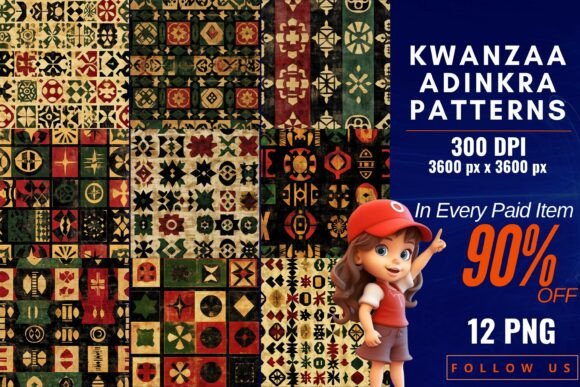
The color palette associated with these designs typically adheres to the Pan-African colors: red, black, and green, often accented with gold. This triad is not arbitrary; it holds profound symbolic weight. Red represents the blood shed in the struggle for freedom, black signifies the people themselves, and green stands for the rich land of Africa. Gold adds a layer of regality and prosperity. For users researching these digital assets, recognizing this intentional color theory is crucial for ensuring that the final output aligns with the intended cultural message.
Evaluating Technical Specifications and Quality
When comparing different options for Kwanzaa Adinkra Patterns Digital Paper, technical specifications play a pivotal role in determining suitability. The standard high-resolution pack typically includes 12 distinct designs, delivered in PNG format. This choice of file type is significant because PNG supports lossless compression, preserving the crispness of vector-like lines and solid color blocks without the artifacts common in JPEG formats.
- Resolution and Dimensions: Files are generally sized at 12″ x 12″ with dimensions of 3600 x 3600 pixels. This square format is versatile, suitable for scrapbooking, social media graphics, and print-on-demand products.
- DPI Standards: A resolution of 300 DPI (dots per inch) is the industry standard for professional printing. This ensures that when users print these backgrounds for physical crafts, such as junk journals or greeting cards, the image remains sharp and free of pixelation.
- File Size and Clarity: Individual files ranging from 8–18 MB indicate a high level of detail. Larger file sizes in this context usually correlate with higher fidelity, allowing for zooming and editing without degradation.
Furthermore, the inclusion of opaque, non-transparent backgrounds simplifies the workflow for many users. While transparent PNGs offer flexibility for layering, opaque backgrounds provide an immediate, ready-to-use canvas. This feature is particularly beneficial for beginners or those working under tight deadlines who do not wish to manage complex alpha channels in design software.
Practical Applications and Use Cases
The versatility of Kwanzaa Adinkra Pattern Backgrounds makes them applicable across various domains. For educators, these patterns can enhance lesson plans related to African history, art, and cultural studies. They provide a visually engaging way to introduce students to symbolic language and cultural identity.
In the realm of personal creativity, junk journal enthusiasts find these packs invaluable. The tactile nature of paper crafting pairs well with the historical resonance of Adinkra symbols. Creating a journal entry on a page featuring symbols of unity or resilience adds a layer of emotional depth to the written word. Similarly, scrapbookers documenting family heritage or community events may use these designs to frame photographs with culturally relevant borders and backdrops.
Professional designers also utilize these assets for branding purposes. Businesses owned by individuals of African descent may incorporate these patterns into marketing materials to signal alignment with community values. Event planners organizing Kwanzaa celebrations can use these digital papers for invitations, banners, and program booklets, ensuring a cohesive and authentic aesthetic throughout the event.
Considerations and Potential Tradeoffs
While the benefits are clear, potential users should consider certain limitations before purchasing or downloading these assets. First, the static nature of digital paper packs means that the designs are fixed. Unlike vector files (such as SVG or AI), which allow for infinite scaling and individual symbol manipulation, raster-based PNGs limit the ability to edit specific elements within the pattern. If a designer needs to change the color of a single symbol or rearrange the layout, they would need advanced graphic design skills or access to vector-editable versions of the assets.
Additionally, the reliance on pre-set color palettes may not suit every project. While the red, black, green, and gold combination is iconic, some modern design trends favor muted tones or alternative color schemes. Users looking for highly customizable, monochromatic, or pastel variations might find these packs too vibrant or traditional for their specific aesthetic goals. In such cases, sourcing custom illustrations or modifying existing assets significantly would be necessary.
Another consideration is the authenticity and attribution aspect. Although these designs are inspired by traditional Adinkra symbols, they are modern digital interpretations. Ethical design practices encourage users to acknowledge the cultural origins of these motifs. When using Kwanzaa Adinkra Patterns for commercial products, it is advisable to research licensing agreements to ensure compliance with any restrictions regarding cultural appropriation or commercial distribution.
Decision-Making Insights
Choosing whether to invest in a Kwanzaa Adinkra Pattern Junk Journal Paper Pack depends largely on the user’s specific needs. For those prioritizing ease of use, high-quality print readiness, and immediate cultural relevance, this type of asset is a strong fit. The 300 DPI resolution and opaque backgrounds reduce the barrier to entry, allowing creators to focus on composition rather than technical troubleshooting.
However, if the primary goal is extensive customization or integration into a larger vector-based design system, users might find more value in purchasing editable vector bundles or commissioning custom work. Similarly, if the project requires subtle, minimalist aesthetics, the bold nature of traditional Adinkra-inspired tribal motifs may feel overpowering. In these scenarios, exploring abstract geometric patterns derived from African textiles but stripped of explicit symbolic imagery might offer a more neutral alternative.
Ultimately, the decision rests on balancing aesthetic preference with functional requirements. For projects centered around education, heritage celebration, or community building, the symbolic weight of Kwanzaa Adinkra Patterns provides an irreplaceable narrative depth. The combination of historical significance and modern digital convenience makes these resources a powerful tool for honoring heritage and celebrating unity through design.